Mount Savage Film Locations: Industrial History and Mountain Vistas
A rugged, vertical brick town steeped in iron-working history, Mount Savage offers producers a gritty, period-perfect alternative to the typical Appalachian aesthetic.
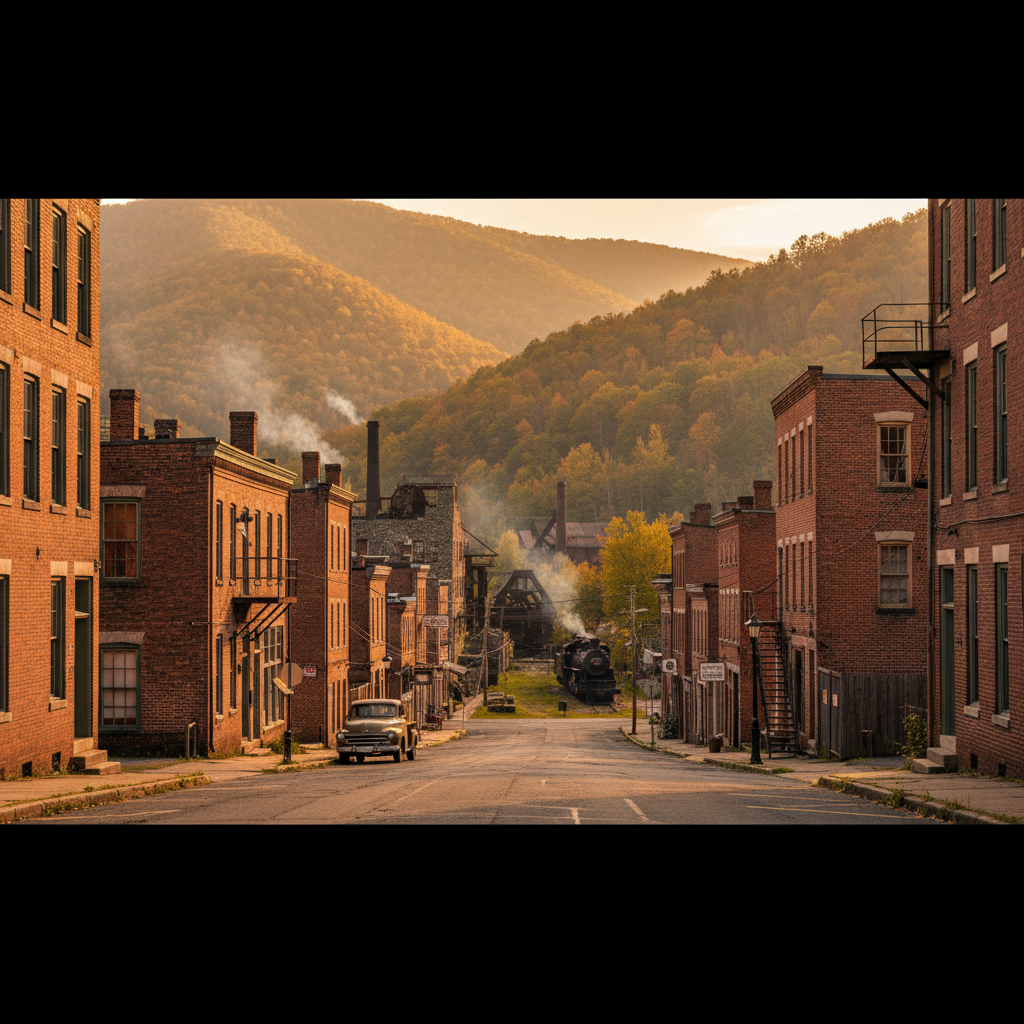
A Living Time Capsule for Period Productions
Mount Savage isn’t just an old town—it’s a visual catalog of Maryland’s industrial evolution. Located just northwest of Cumberland and a short climb from LaVale, this community served as a 19th-century manufacturing powerhouse, credited with rolling the first iron T-rails in America. For a location scout, this history translates into a rare concentration of brick architecture, steep verticality, and narrow alleys that could easily pass for 1880s Pennsylvania or 1920s Appalachia.
The town’s layout is defined by its topography. Houses are perched on the hillsides of Big Savage Mountain, creating dramatic sightlines where the roofline of one row house sits level with the front door of the one above it. This verticality offers unique camera angles that you won't find in the flatter valley towns. The "Main Street" corridor retains a gritty, authentic texture, with red-brick façades and stone foundations that haven't been sanitized by modern development.
Industrial Heritage and the Iron Works Remnants
The skeletal remains of the Mount Savage Iron Works and the brick-making industry provide a rugged backdrop for gritty, industrial, or post-apocalyptic scenes. Unlike the polished tourist spots along the C&O Canal, the sites here feel raw and lived-in. The proximity to the Western Maryland Scenic Railroad tracks adds another layer of utility for period pieces involving steam locomotives or historic rail transport.
Producers looking for heavy textures—weathered brick, rusted iron, and overgrown rail sidings—will find them concentrated here. The town is physically squeezed between the slopes of the Allegheny Front, meaning the sun disappears behind the ridges early, giving you extended "golden hour" lighting conditions and deep, moody shadows that are perfect for noir or historical drama. If you need to source specialized equipment or local tech for these sites, check our industry directory to see available regional resources.
Small-Town Interiors and Atmospheric Streetscapes
Beyond the industrial footprint, Mount Savage offers a variety of "everyman" residential locations. From the tightly packed worker housing that mirrors the brick rows of Baltimore or Pittsburgh to more isolated farmhouses on the outskirts heading toward Frostburg, the range is surprising for such a compact footprint.
The streetscapes are particularly valuable for films set in the mid-20th century. High-clearance cinematic shots can capture the winding roads that snake up the mountain without modern glass-and-steel skyscrapers breaking the horizon. To understand the permitting process for closing these secondary roads or using public right-of-ways, refer to our Western Maryland filming guide. The local community is accustomed to the pace of mountain life and is generally receptive to production presence, provided the logistics are handled with local insight.
Logistics: The Gateway to the High Plateau
Mount Savage serves as a strategic base of operations for productions filming in the higher elevations of Allegany and Garrett Counties. You are positioned roughly 2 hours from both Washington D.C. and Baltimore, and about 2.5 hours from Pittsburgh via I-68. This makes it feasible to run a "hub and spoke" production model:
- Lodging: Base your crew in Cumberland or Frostburg (both 10-15 minutes away) for hotel infrastructure and catering.
- Terrain shift: Within a 30-minute drive, you can move from the industrial brick streets of Mount Savage to the high-altitude forests of Big Savage Mountain or the expansive waters of Deep Creek Lake.
- Support: If you are a local vendor or property owner in the area, we encourage you to get listed to help incoming scouts find the assets they need.
The weather here is a factor; the Allegheny Front catches the brunt of weather systems moving from the west. This means heavier snow in the winter and more dramatic cloud formations than you’ll see in the Piedmont regions of Maryland. For productions needing serious winter aesthetics or "moody" mountain mist, Mount Savage delivers more reliably than anywhere else in the state.
Frequently asked questions
How far is Mount Savage from Cumberland and major highways?
Mount Savage is approximately 9 miles (15 minutes) from Cumberland and about 10 minutes from Frostburg. It is easily accessible via MD-36.
What specific eras of history can Mount Savage represent?
The town is highly effective for any period between 1840 and 1950. Its roots in the iron and brick industries mean the architecture is primarily mid-to-late 19th century.
Are there weather considerations for filming on Big Savage Mountain?
The town sits at a higher elevation than Cumberland and can experience significantly more snowfall and wind. Shoots scheduled for late autumn or winter should plan for mountain weather conditions and potential road icing on steep grades.
Is it possible to close streets for period-accurate shots?
While Mount Savage is a residential community, we can assist in coordinating with county officials for road closures on MD-36 or local side streets. Advanced notice is required for any stunts or high-impact sequences.
Where should my crew stay if we are filming in Mount Savage?
Cumberland and Frostburg offer the nearest concentration of hotel chains and large-scale catering. Mount Savage itself has local taverns and small shops suitable for craft services, but large crews will typically lodge in the neighboring cities.
See more in the directory or submit a production request.